🚨 Description: The Error That Shouldn’t Exist
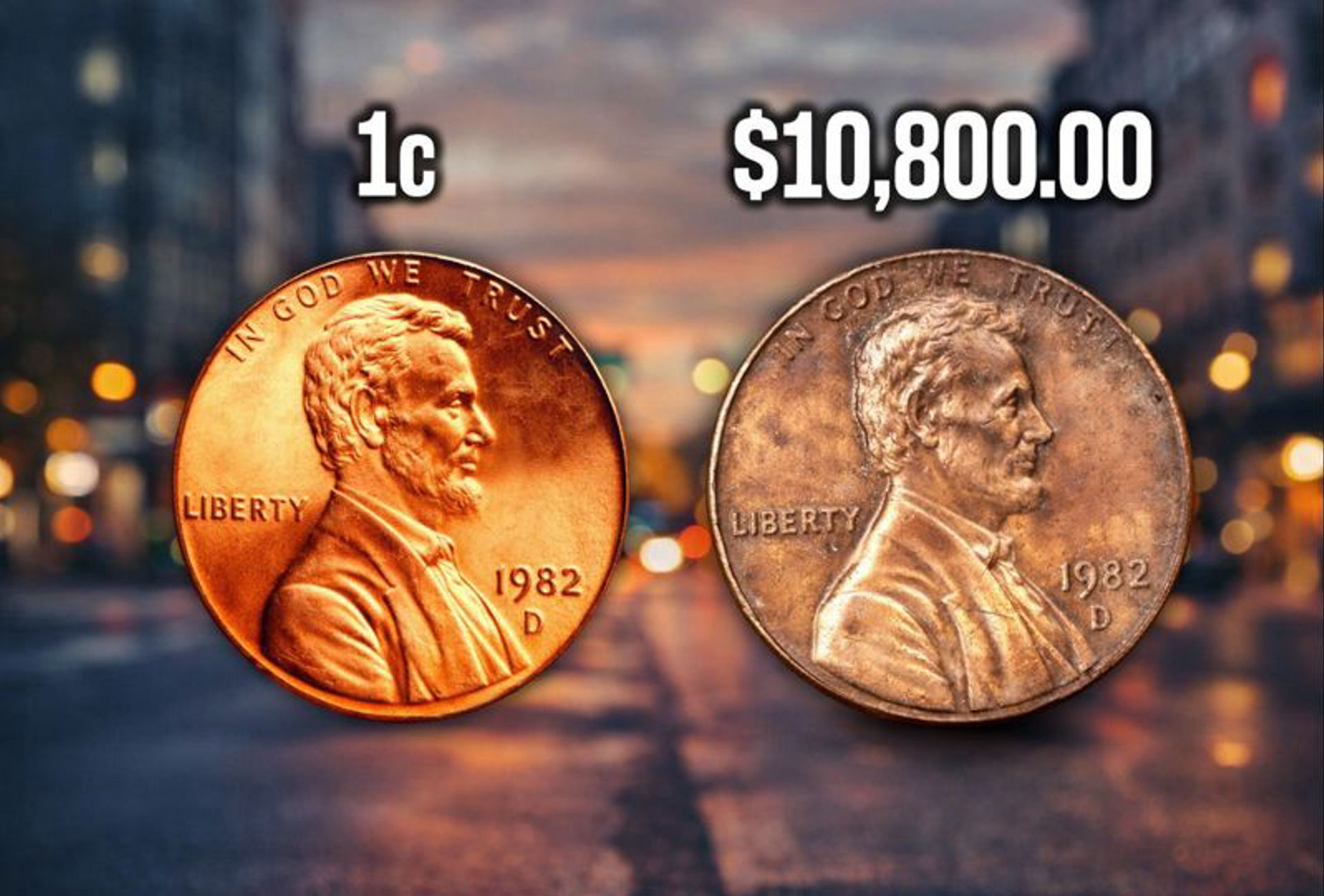
In 1982, the U.S. Mint transitioned from a 95% copper composition to a copper-plated zinc core. During this transition, the Denver Mint was only authorized to strike “Small Date” designs on the new zinc planchets. However, a few leftover copper planchets were accidentally struck with the Small Date die, creating a “transitional error” that went undiscovered for decades. The first authentic example was not confirmed until 2016.
[Value] 💰
The rarity of this coin makes it one of the most valuable modern pennies in existence:
-
Record Sale: A single AU-58 specimen sold for $18,800 in 2017.
-
Market Peak: Another authenticated example fetched over $24,000 in 2021.
-
Current Estimates: Experts value these coins between $10,000 and $25,000+ depending on the condition and professional grade.
[Call to Action] 📢
Stop spending your 1982 pennies! Before you empty your coin jar, follow these steps:
-
Separate your 1982-D pennies (look for the “D” mint mark under the date).
-
Identify the “Small Date” vs. the common “Large Date”.
-
Weigh every Small Date “D” penny you find; a standard zinc penny will not make you rich, but a copper one will.
🔍 Look For: Small Date vs. Large Date
The difference is subtle but vital for determining value:
-
Small Date: The “8” has a smaller top loop, and the numbers are further from the rim. The “2” in the date is also noticeably curvier than on the large date.
-
Large Date: The numbers are taller, and the “2” is almost touching the rim.
📈 Market Value & Top Auction Houses
If you find a potential 1982-D Small Date Copper, these premier auction houses are the standard for high-value sales:
-
Heritage Auctions: Known for handling the $18,800 and $24,000 record-breaking sales of this specific variety.
-
Stack’s Bowers Galleries: America’s oldest rare coin auctioneer and the house that sold the first confirmed 1982-D copper specimen.
-
GreatCollections: A top choice for selling certified rare coins through weekly online auctions.
✅ Tips for Collectors
-
Always Weigh the Coin: Visual identification is not enough. You must use a precise digital scale.
-
Check Your Luster: Copper pennies (3.11g) often have a deeper, more reddish luster than zinc pennies (2.5g), which can sometimes look “bubbly” under the plating.
-
Never Clean Your Find: Cleaning a rare coin can destroy its numismatic value by up to 90%.
-
Use a Loupe: A 7x to 14x magnifying loupe is essential for accurately identifying the Small Date variety.
🛡️ 4. 5-Step Authentication Protocol (Must Read!)
Follow this protocol before you assume you’ve found a fortune:
-
Weight Verification: Place the penny on a scale that measures to 0.01g. It must weigh 3.11 grams. If it weighs 2.5 grams, it is a common zinc penny.
-
Date Alignment: On a Small Date, the tops of the numerals “1-9-8-2” align on a single, solid invisible plane.
-
Magnet Test: While both copper and zinc pennies are generally non-magnetic, this test helps rule out certain foreign counterfeits.
-
Surface Inspection: Genuine mint errors show consistent metal flow and sharp detail under magnification, not “mushy” features typical of fakes.
-
Professional Grading: If your coin weighs 3.1g and is a Small Date “D,” submit it immediately to PCGS or NGC for official certification. Uncertified coins will not reach five-figure prices.
🔍 How to Check If Your Nickel Is Valuable
While searching for pennies, keep an eye out for these rare nickels:
-
The “Speared Bison”: Look at 2005-P nickels for a long die crack that looks like a spear going through the bison’s back (worth up to $400).
-
1942-1945 War Nickels: These contain 35% silver; look for a large “P,” “D,” or “S” mint mark above the dome of Monticello.
-
Overdate Errors: The 1942-P Jefferson nickel with an “overdate” is a major rarity worth approximately $600 in uncirculated condition.
-
One-Sided Nickels: Genuine “uniface” errors, where one side is completely blank, can be worth $1,000 to $50,000.
🏁 Conclusion & Final Thoughts
The 1982-D Small Date Copper penny is a “modern-day treasure hunt” because more examples likely exist in circulation. As the U.S. Mint prepares to release special 2026 Semiquincentennial designs for other coins, the penny remains a staple for error hunters. The difference between a common 1-cent coin and an $18,800 rarity is exactly 0.61 grams of copper—so start weighing your change.
Would you like me to identify a specific mint mark or explain the “Shoulder Fold” variety on rare Canadian pennies?