 Before You Spend That Old Quarter…
Stop what you’re doing and take a closer look at your change.
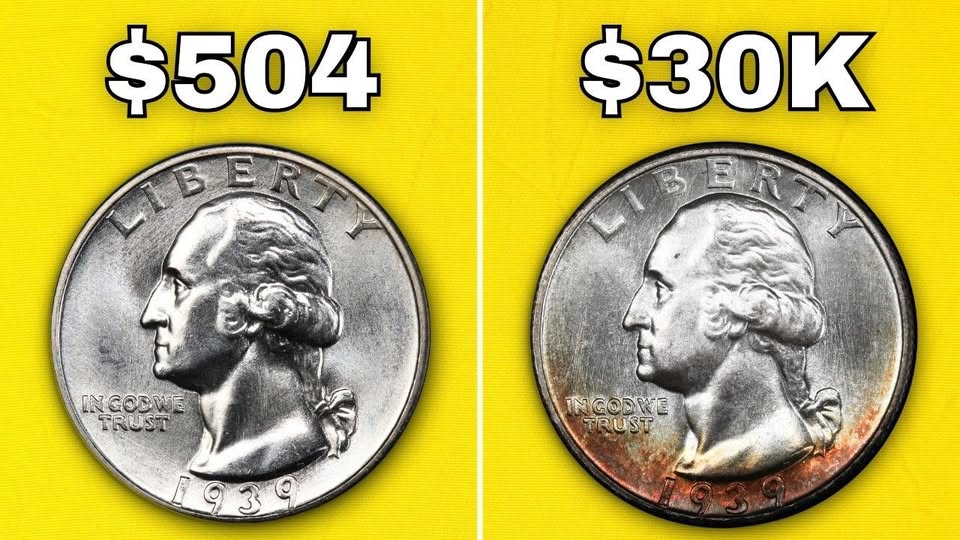
Some 1939 Washington quarters—which look completely ordinary—have sold online for hundreds, thousands, and even $30,000 at major auction houses like Heritage Auctions.
All prices discussed in this guide are backed by real auction data, and collectors have paid these amounts willingly.
Let’s break everything down step by step so you know exactly what to look for 
 Step 1: Why the 1939 Quarter Matters
The Washington quarter was first introduced in 1932, making 1939 an early issue in the series.
All 1939 quarters are:
 90% silver, 10% copper
- Weight: 6.25 grams
 Valuable even at melt value
But condition, mint mark, and errors are what turn these coins into five-figure collectibles.
 Step 2: 1939-D Washington Quarter (Denver Mint)
You can identify a Denver-minted quarter by the small “D” mint mark on the back, bottom center of the coin.
 Mintage:
- 7,920,000 coins
- Sounds like a lot—but for U.S. Mint standards, it’s relatively low
 Auction Results:
- MS67 (PCGS) →
 $360
$360 - MS67+ (PCGS) → $1,020
- MS68 (NGC) → $2,280
 About Toning
Some of these coins show heavy toning (natural color change caused by oxidation).
Toning can increase or decrease value, depending on eye appeal.
The key takeaway:
 Every grading point matters.
 Step 3: 1939-D “D Over S” Mint Mark Error
Sold for $690
This one is easy to miss—but incredibly important.
 What Happened?
During production, a “D” mint mark was punched over an “S” mint mark.
This should never have happened, making it a legitimate U.S. Mint error.
- Graded MS65 (PCGS)
- Lower grade—but still highly valuable due to the error
 A 25-cent coin turning into $690 is why collectors obsess over mint marks.
 Step 4: 1939 Philadelphia Quarter (No Mint Mark)
Philadelphia coins usually have no mint mark at all.
Mintage:
- 33,541,795 coins
- Much higher than Denver or San Francisco
Auction Results:
- MS67 (PCGS) → $119
- MS68 (PCGS) → $1,920
Even with high mintage, top-grade examples are extremely rare.
 Reminder:
One grading point can mean thousands of dollars.
 Step 5: 1939 Proof Washington Quarters
Proof coins are made one at a time using:
- Higher striking pressure
- Specially prepared dies
- Superior finishes
Originally, proofs were made as presentation examples, not for circulation.
Auction Results:
- PR67 (NGC) → $276
- PR68 (NGC) → $1,860
Proofs are rarely found in circulation—and never in this condition.
 Step 6: 1939-S Washington Quarter (San Francisco Mint)
San Francisco usually struck fewer coins in the early 1900s.
Mintage:
- 2,628,000 coins (low!)
Auction Results:
- MS64 (PCGS) → $144
- MS67 (PCGS) → $540
But here’s where things get wild
 Step 7: The $30,000 Quarter (1939-S MS68 CAC)
Sold for $30,000
This coin has everything collectors want:
 MS68 grade (near perfect)
- Stunning natural toning
 CAC sticker
 What Is CAC?
CAC verifies that a coin is:
- Accurately graded
- High quality for the grade
That small green sticker can dramatically increase value.
From $144 to $30,000—grading makes all the difference.
 Step 8: 1939-S Doubled Die Obverse Error
Now for a tricky one.
What to Look For:
- Doubling on the front (obverse) of the coin
- Visible in letters and numbers near the lower left area
Auction Results:
- MS64 (PCGS) → $144
- MS67 (PCGS) → $1,020
The stronger the doubling, the more collectors will pay.
 Final Advice: Handle With Care
If you believe you have a rare quarter:
 Do not clean it
Do not damage it
Get opinions from multiple experts
Trust certified grading companies like PCGS or NGC
Finding a rare coin is rare—but it does happen.