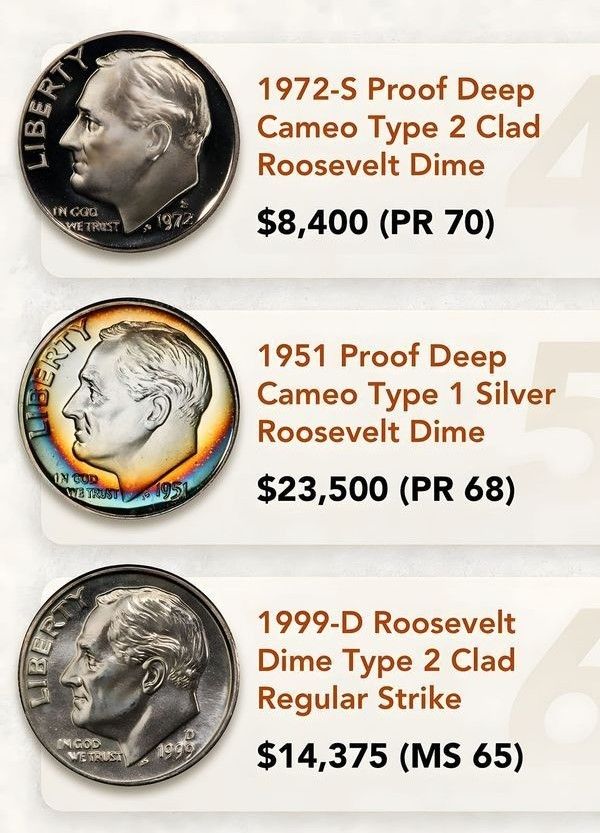
However, the dimes you are most likely to find—and the key to the multi-thousand dollar finds—lie in specific minting errors and pristine condition that command staggering premiums.
1. The $14,375 Error: Dime Struck on a Cent Planchet
One of the most valuable modern errors involves an accidental mix-up in the striking process.
-
The Error: An extremely rare error occurs when a dime die strikes a copper cent (penny) planchet instead of the dime’s standard copper-nickel clad planchet. This results in a coin that is copper-colored and thicker than a normal dime.
-
The Key Year: The 1999-D Dime Broadstruck on a Cent Planchet is a specific, highly-publicized example of this error.
-
Value: Only a few are known to exist. A single example graded MS65 sold for $14,375. A slight downgrade to MS64 causes a significant loss in value to $6,325, demonstrating how critical the grade is for error coins.
2. The $23,500 Prize: The “No-S” Proof Dimes
These are the legendary, ultra-rare errors that can easily make a coin collector’s dream come true, with values reaching six figures.
-
The Error: Proof coins, struck in San Francisco (“S” mint mark), are intended for collectors and have a mirror-like finish. Occasionally, the die used to strike these proofs is missing the “S” mint mark.
-
Key Dates for “No-S” Errors:
-
1975-S No-S Proof: The undisputed “King” of the series, worth $100,000+ in top quality.
-
1968-S No-S Proof: A more common, but still incredibly valuable, example can sell for over $20,000.
-
1983-S No-S Proof: Another sought-after error.
-
-
How to Spot: Look for a proof coin (mirror-like surface) dated 1968, 1970, 1975, or 1983 that does not have an “S” mint mark above the date .
3. High-Grade Silver Dimes (1946–1964)
While millions of these were minted, achieving a high grade for specific dates results in massive value spikes.
-
Silver Content: All Roosevelt Dimes dated 1964 or earlier are composed of 90% silver. Even in circulated condition, these are worth at least their silver melt value, which is currently many times the ten-cent face value.
-
The Condition Premium: For coins dated 1946–1964, the value only jumps dramatically in pristine, uncirculated grades (MS-67 and higher).
-
1946: The common 1946 dime in perfect MS69 condition sold for $12,650.
-
1946-D: A Denver mint 1946 dime in MS68 condition sold for $1,300, while a pristine example with a sharp reverse (Full Bands) sold for $4,888.
-
4. The “Full Bands” (FB) Premium
For serious collectors, the detail on the reverse of the dime is everything.
-
The Feature: The reverse of the Roosevelt Dime features a torch flanked by olive and oak branches. The “Full Bands” (FB) or “Full Torch” designation means the horizontal bands binding the torch are fully struck and clearly separated.
-
Value Impact: The FB designation often triples or quadruples the value of an uncirculated dime. A regular uncirculated 1999-D dime might be worth about $2-$5, but an MS68 Full Bands example sold for $2,000.
🛠️ Your Step-by-Step Hunting Guide
-
Separate Silver: Check all dimes dated 1964 and earlier. These are 90% silver and are worth the most as a base value.
-
Look for No-S: Check all proof dimes (mirror-like surface) for the absence of the “S” mint mark.
-
Inspect for Errors: Examine 1999 dimes for unusual color/weight (cent planchet error) and other years for dramatic doubling.
-
Check the Torch: For high-grade silver and post-1965 dimes, look for the crisp Full Bands on the torch for maximum value.
Would you like me to search for the current value of the most valuable error, the 1975-S No-S Proof Roosevelt Dime?