This guide explores the fascinating world of numismatics, focusing on the pennies that have transcended their one-cent face value to become legendary treasures worth thousands, or even millions, of dollars.
1. 1943-D Lincoln Bronze Cent
The 1943-D Bronze Cent is arguably the “Holy Grail” of Lincoln pennies. During World War II, the U.S. Mint switched to zinc-coated steel to conserve copper for the war effort. However, a few bronze planchets (blanks) from 1942 were accidentally left in the bins and struck with 1943 dies.
-
Why it’s valuable: It is an “off-metal” error. Only one example from the Denver Mint is known to exist.
-
Recent Sale: A 1943-D bronze cent sold for a staggering $504,000 in 2019.
2. 1944-S Lincoln Steel Penny
The reverse of the 1943 error happened in 1944. As the Mint switched back to copper, a few leftover steel blanks from the previous year were struck.
-
Why it’s valuable: While Philadelphia and Denver steel pennies exist, the San Francisco (S) version is the rarest of the 1944 steel errors.
-
Value: In high-grade condition, these can exceed $400,000.
3. 1958 Doubled Die Obverse Lincoln Cent
This is a “Doubled Die” variety, where the coin’s design is struck twice at slightly different angles, creating a blurry or “ghosted” effect.
-
Why it’s valuable: Only three authentic examples are known to exist. The doubling is most prominent on the words “LIBERTY” and “IN GOD WE TRUST.”
-
Record Sale: An MS-64 specimen once fetched $336,000.
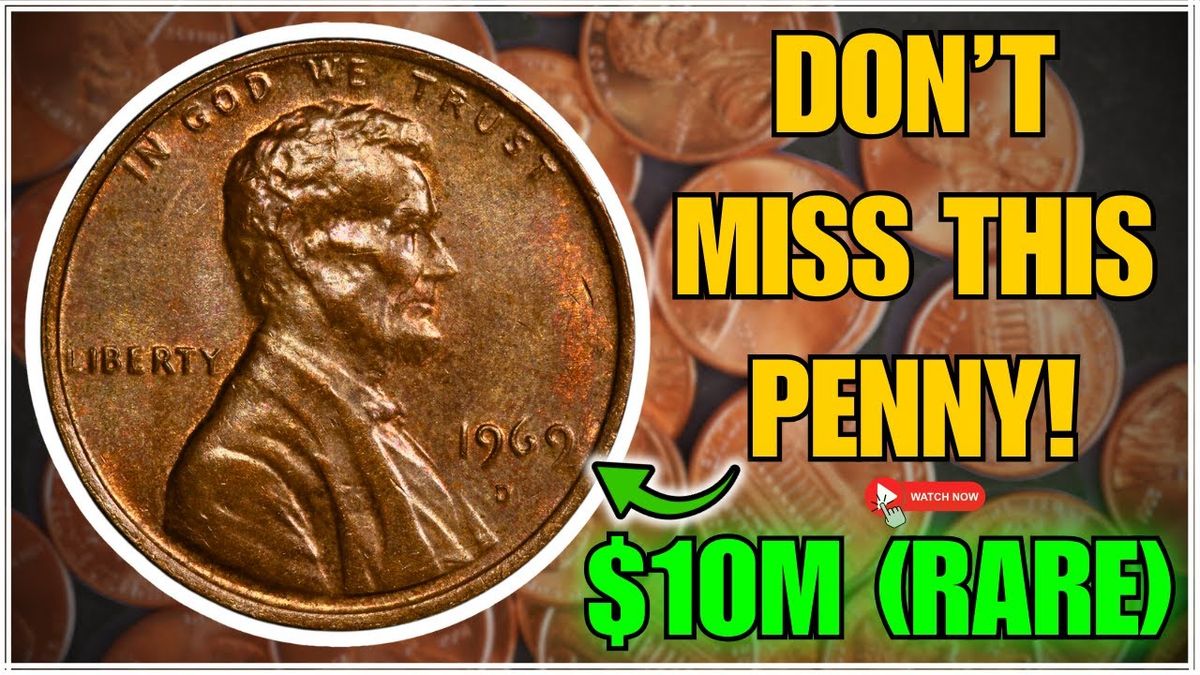
4. 1969-S Doubled Die Obverse Penny
The 1969-S Doubled Die is one of the most famous modern rarities. It features dramatic, clear doubling on the date and the lettering on the front (obverse).
-
The Rare “D” vs. “S”: It is critical to note that the 1969-S (San Francisco) is the ultra-rare version. While there is a 1969-D (Denver), it is common unless it possesses a specific mint error like a “No FG” (missing engraver initials) or a rare Doubled Die of its own (which is far less dramatic than the ‘S’ version).
-
Auction Record: A high-grade 1969-S can sell for over $125,000.
5. 1909-S V.D.B. Lincoln Penny
When the Lincoln cent debuted in 1909, the designer’s initials (V.D.B. for Victor David Brenner) were placed on the bottom reverse. After a public outcry that the initials were too prominent, they were removed just days into production.
-
Why it’s valuable: The low mintage (only 484,000) from the San Francisco Mint makes it the “Key Date” for every Lincoln collector.
-
Value: Roughly $1,000 to $50,000+ depending on condition.
6. 1943 Bronze Cent (Philadelphia)
Similar to the Denver version but slightly more common (though still extremely rare with about 20 known).
-
The Magnet Test: If you find a 1943 penny that is brown (copper) and it does not stick to a magnet, you might have a fortune. If it sticks, it’s just a copper-plated steel penny (a common fake).
-
Value: Can reach $100,000 to $200,000.
7. 1914-D Lincoln Penny
With a mintage of only 1,193,000, the 1914-D is a rare “Key Date” from the Denver Mint. Many were lost to circulation, making high-grade “Mint State” examples incredibly pricey.
-
Value: Can fetch between $15,000 and $100,000 in pristine condition.
8. 1922 “No D” (Plain) Lincoln Penny
In 1922, the Philadelphia Mint produced no pennies; only Denver (D) did. However, due to a worn-out die, the “D” mint mark disappeared on some coins, making them look like Philadelphia strikes.
-
The Error: These are called “1922 Plain” or “No D” cents.
-
Value: High-grade examples can reach $50,000 to $80,000.
9. 1955 Doubled Die Obverse Penny
This is perhaps the most visually striking error in U.S. history. The doubling is so severe that it can be seen from across a room without a magnifying glass.
-
The Story: Roughly 20,000–24,000 were released into cigarette packs in New England before the Mint noticed.
-
Value: $1,500 to $125,000 depending on the “Red” color and luster.
10. 1856 Flying Eagle Cent
Before the Lincoln cent, there was the Flying Eagle. Technically a “pattern” coin (a test run), only about 1,000–2,000 were minted.
-
Why it’s valuable: It is the first small-sized cent ever produced by the U.S. Mint.
-
Value: Even in “Good” condition, it’s worth $6,000; in Mint State, it can top $150,000.
A Note on the 1969-D Penny
While the 1969-S is the million-dollar headline, the 1969-D remains popular among “roll hunters.” Look for:
-
Missing “FG”: On the reverse, to the right of the Lincoln Memorial, the initials “FG” (Frank Gasparro) may be missing due to over-polished dies.
-
Luster: Because the Mint used new hubs in 1969, the Denver strikes are often incredibly sharp. A 1969-D in an “MS-67” grade is worth thousands because of its rarity in that perfect state.
Would you like me to create a visual comparison table of these coins with their estimated auction values and identifying marks?