If you’ve spent any time on social media lately, you’ve likely seen the viral images of common-looking coins with eye-watering price tags. One of the most famous examples is the 1977 Jefferson Nickel, often shown with a claim that it is worth a staggering $14,800. While the thrill of finding a small fortune in your pocket is real, it is important to separate internet myths from numismatic reality.
The truth? A spectacular 1977 Jefferson Nickel error did indeed sell recently, but for $2,115—not the $14,800 often quoted in clickbait headlines. Here is your definitive 2025 guide to identifying this rare error and understanding why some coins are worth thousands while others are only worth five cents.
The $14,800 Myth vs. The $2,115 Reality
In the world of coin collecting, “the story” often gets inflated as it travels across the web. The $14,800 figure usually stems from an asking price on an unverified listing or a misunderstanding of a specific high-grade auction. However, documented sales for authenticated 1977 Jefferson Nickel errors typically hover between $300 and $2,200, depending on the severity of the error and the coin’s condition.
Why the 1977 Nickel is Special
Most 1977 nickels are common “business strikes” minted in Philadelphia (no mint mark) or Denver (“D” mint mark). They are composed of 75% copper and 25% nickel and are worth exactly face value unless they are in flawless, uncirculated condition.
The valuable version—the one that sold for over $2,100—is a Wrong Planchet Error. This occurs when a Jefferson Nickel design is accidentally struck onto a copper planchet intended for a Lincoln Penny.
Step-by-Step Identification Guide
If you find a 1977 nickel that looks “off,” follow these steps to see if you’ve actually struck gold (or, in this case, copper).
1. The Color Test
A standard nickel has a silver-colored, cupro-nickel luster. The rare 1977 error was struck on a copper cent planchet, giving it a distinct reddish or orange-brown hue. If your nickel looks like a penny but has Jefferson’s face on it, you have found a potential “wrong planchet” error.
2. The Weight (The Ultimate Decider)
Because different coins use different metal compositions, their weights are precisely regulated. This is the most reliable way to spot a fake.
-
Standard 1977 Nickel: 5.0 grams.
-
1977 Nickel on Cent Planchet: ~2.5 grams.
-
1977 Nickel on Dime Planchet: ~2.27 grams.
Pro Tip: Use a digital jewelry scale that measures to two decimal places. If your nickel weighs significantly less than 5 grams, it is almost certainly an error coin.
3. The Diameter and Rim
A penny blank is smaller than a nickel die. When the larger nickel die strikes the smaller penny blank, the metal doesn’t reach the edges of the die. This often results in a coin that is slightly smaller than a standard nickel and may have a “fishtailed” or distorted rim where the design was cut off.
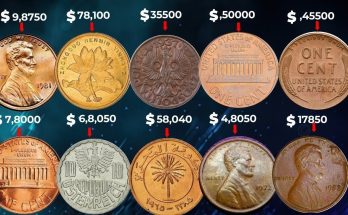
Context: The 1993-D $51,750 Penny
The other photo often associated with these guides shows two 1993-D pennies, one of which is valued at $51,750. This is another “Wrong Planchet” error—in this case, a 1993-D Lincoln Cent struck on a Roosevelt Dime planchet.
These “transitional” errors are the holy grails of modern pocket change. The reason the 1993 penny is worth $51k while the 1977 nickel is worth $2k comes down to Rarity and Condition (Grade). A coin in “Mint State” (MS65 or higher) with original luster will always command a massive premium over a circulated, scratched version.
2025 Value Guide: What Is Your Coin Worth?
| Error Type | Estimated 2025 Value | Key Feature |
| 1977 Nickel (Standard) | $0.05 – $1.00 | Common circulation. |
| 1977-D Nickel (Full Steps) | $200 – $4,300+ | Exceptional strike quality. |
| 1977 Nickel on Cent Planchet | $300 – $2,115 | Copper color, 2.5g weight. |
| 1977-S Nickel on Dime Planchet | $500 – $1,500+ | Proof strike, silver color, 2.27g. |
How to Handle Your Find
If you find a coin that matches the criteria for a 1977 “wrong planchet” error, do not spend it, and more importantly, do not clean it. Cleaning a coin with chemicals or even a cloth can create micro-scratches that destroy up to 90% of its numismatic value.
Final Steps for Success:
-
Protect It: Place the coin in a PVC-free plastic “flip” or a small container to prevent further wear.
-
Authenticate: To sell a coin for $2,000+, it must be “slabbed” (certified) by a professional grading service like PCGS or NGC.
-
Research Auctions: Check recent sold listings on sites like Heritage Auctions or GreatCollections rather than relying on eBay “asking” prices, which are often inflated.
The 1977 Jefferson Nickel error is a reminder that even “worthless” change can hide significant value. While $14,800 might be a stretch for most finds, a $2,000 payday for a nickel is still a win by any standard.
Would you like me to help you find a local coin club or show where you can take your coins for a free preliminary evaluation?